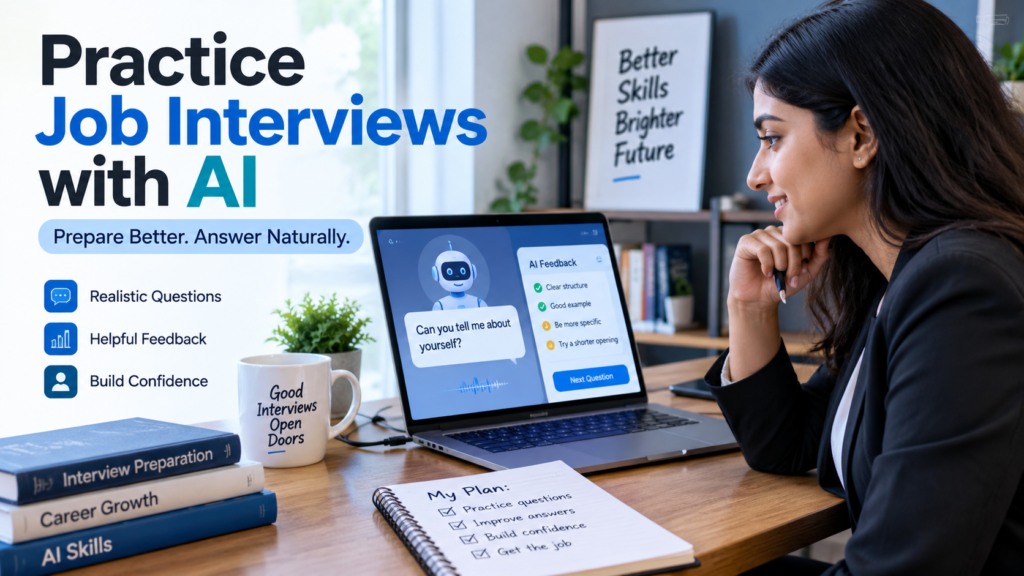
Using AI for job interview practice can help you rehearse realistic questions, improve weak answers, and prepare for follow-up questions before the real interview.
There is a strange moment that happens before many interviews.
You close the company website. You check your resume one more time. You already know the obvious questions: introduce yourself, talk about your strengths, explain why you want the role.
And yet, you still do not feel ready.
The problem is usually not a lack of information. It is a lack of rehearsal.
Knowing what you want to say and being able to say it clearly under pressure are two different skills. This is where AI can become surprisingly useful.
In 2026, one of the smartest ways to use AI for interview preparation is not to ask it for “perfect answers.” It is to make it behave like a demanding practice partner.
Used that way, AI can help you discover weak explanations, prepare for unexpected questions, organise real experiences, and become more comfortable speaking about your work.
Here is a practical way to do it.
Treat AI Like a Rehearsal Room, Not a Script Writer
The easiest shortcut is also one of the least useful:
“Write the perfect answer to ‘Tell me about yourself.’”
AI can produce something polished in seconds.
But a polished paragraph is not the same as interview preparation.
You may memorise the first few lines and still struggle as soon as the interviewer interrupts you or asks, “Can you give me an example?”
A better approach is to use AI to rehearse your thinking.
Instead of asking:
“What should I say?”
Ask:
“What part of my answer would an interviewer question?”
That small difference changes AI from a writing machine into a coaching tool.
Build a Role Map Before Practising Questions
Do not begin with a list of “50 common interview questions.”
Begin with the role.
Read the job description and write down four things:
What will this person actually do?
What skills seem essential?
What problems will they probably have to solve?
What kind of behaviour does the employer appear to value?
Suppose a job description repeatedly mentions client communication, reporting, deadlines, teamwork, and problem-solving.
Those words are not filler.
They are clues.
You can give AI a simplified version of the job description and say:
Review this role and create a role map. Separate it into key responsibilities, skills, likely challenges, and qualities an interviewer may want to test.
Now you are no longer preparing blindly.
You are preparing around the job itself.
Create Your Own Interview Evidence Bank
Before running mock interviews, make a small collection of real examples from your experience.
You do not need dozens.
Five or six useful situations are enough.
Think about moments when you:
- solved a problem,
- handled pressure,
- helped a team,
- learned something quickly,
- made a mistake,
- improved a process,
- dealt with a difficult person,
- completed something important.
These examples become your raw material.
Then give AI a short description of each situation and ask:
What kinds of interview questions could this real experience help me answer?
This is much better than inventing a new story for every question.
One genuine experience can often answer several different interview questions depending on how you explain it.
Practise in Rounds Instead of Doing One Long Mock Interview
A long mock interview sounds realistic, but it can become tiring and unfocused.
Try shorter rounds.
Round One: Easy Questions
Start with questions you expect.
For example:
- Tell me about yourself.
- Why are you interested in this role?
- What are your strongest skills?
The goal here is not perfection.
The goal is to become comfortable speaking.
Round Two: Experience Questions
Now move into situations from your past.
Ask AI to question you about teamwork, mistakes, deadlines, conflict, learning, or responsibility.
Round Three: Pressure Questions
Finally, ask AI to challenge your answers.
For example:
Ask me questions that require clarification. If my answer sounds vague, interrupt with a realistic follow-up.
This third round is often the most valuable because real interviews rarely follow a clean script.
Use the “Answer, Challenge, Improve” Method
One of the simplest practice systems is a three-step loop.
1. Answer
Respond without looking at notes.
2. Challenge
Ask AI:
What would make an interviewer doubt or question this answer?
3. Improve
Answer the same question again using your own words.
Do not ask AI to rewrite the whole response unless you are completely stuck.
The purpose is to improve your communication, not replace it.
After two or three attempts, you will usually notice that your answer becomes shorter, clearer and easier to explain.
Make AI Test Your Specific Claims
Candidates often use statements such as:
“I am a strong problem solver.”
“I work well under pressure.”
“I am a good team player.”
These claims are easy to say.
The challenge is proving them.
Give one of your answers to AI and ask:
Highlight every claim in this answer that needs evidence or an example.
You may discover that half of your answer is made of general statements.
Now replace those statements with actual moments.
Instead of:
“I am good at handling difficult customers.”
You might explain a situation where a customer was frustrated, what you did, and what happened afterward.
That feels more believable because it is specific.
Prepare for the Second Question, Not Just the First
Many interview answers sound strong until the interviewer asks one more question.
You say:
“I managed an important task successfully.”
The interviewer asks:
“What made it difficult?”
Then:
“What did you personally do?”
Then:
“What would you change if you had to do it again?”
This is why follow-up practice matters.
After every important answer, ask AI:
Ask me two follow-up questions that would force me to explain this situation in more detail.
If you can comfortably answer those, you probably understand your example well enough to discuss it naturally.
Use AI to Cut Long Answers
Some candidates struggle because they say too little.
Others have the opposite problem.
They begin answering one question and, two minutes later, they are still talking.
AI can help here as well.
Write or transcribe your answer and ask:
Which parts of this answer are necessary, which parts are repetitive, and where does the main point arrive too late?
This is different from asking AI to shorten the answer automatically.
You want to understand what should be removed.
Over time, you start noticing unnecessary details yourself.
Practise Explaining Technical Ideas to a Non-Expert
This is especially useful for technology, analytics, finance, marketing, operations and similar roles.
An interviewer may understand the technical subject.
But they are also judging whether you can explain it clearly.
Choose a concept you expect to discuss and ask AI:
Give me one technical question related to this role. After I answer, tell me whether a non-expert manager would understand my explanation.
You may know the subject extremely well and still discover that your explanation is full of jargon.
That is useful feedback.
Being able to simplify a complex idea is often a professional skill by itself.
Create Different Interview Personalities
Not every interviewer behaves the same way.
One may be friendly.
Another may be quiet.
Another may challenge every answer.
You can practise this intentionally.
For example:
Interview me as a hiring manager who is polite but sceptical. Do not praise every answer. Ask for clarification whenever my response lacks evidence.
On another day:
Interview me as a fast-moving recruiter conducting a short screening call.
Or:
Interview me as a manager focused heavily on teamwork and accountability.
Changing the interview style prevents you from becoming comfortable with only one predictable format.
Do One Session Without Typing
Typing creates extra thinking time.
Real interviews usually do not.
Once you have practised your answers, move away from the keyboard.
Read a question.
Answer it aloud.
Record yourself on your phone if you want.
When you listen back, pay attention to:
- long pauses,
- repeated words,
- sentences that never seem to end,
- answers that begin too far from the actual question.
You may discover issues that are invisible when you only practise through text.
AI can help you prepare the ideas, but speaking practice is what turns those ideas into interview-ready communication.
Do Not Try to Sound “AI Professional”
There is a particular style of answer that sounds impressive on a screen but strange in a conversation.
For example:
“Throughout my professional journey, I have consistently demonstrated a proactive approach towards cross-functional stakeholder collaboration.”
Technically, there is nothing wrong with it.
But many people would never naturally say that sentence.
A simpler version might be:
“I often worked with different teams, so I learned how important clear communication is when priorities change.”
Same idea.
More human.
If AI gives you language that feels too formal, ask:
Keep the meaning but make this sound like something a real person would comfortably say in an interview.
Then edit it again yourself.
Use AI for Weak Areas, Not Everything
You do not need AI for every question.
Spend more time on the areas that make you uncomfortable.
Maybe you struggle with:
- explaining a career gap,
- talking about failure,
- answering salary questions,
- discussing why you left a job,
- showing leadership experience,
- explaining a weakness,
- applying without much experience.
Tell AI exactly what makes the question difficult.
For example:
I am a fresher and I struggle when interviewers ask about professional experience. Practise questions around this issue with me. Help me answer honestly without pretending I have experience I do not have.
That is far more useful than generic interview advice.
Keep Private Information Out of Your Practice
AI interview preparation should not require confidential data.
You do not need to upload internal company reports, customer details, passwords, identification numbers, private financial information, or restricted project documents.
If an example contains sensitive information, simplify it.
Instead of naming a client, say:
“a customer”
Instead of mentioning confidential financial numbers, say:
“the project was over budget.”
You can practise the story without exposing information that should remain private.
A Simple 20-Minute Practice Session
If your interview is close and you do not have hours to prepare, try this.
Minutes 1–4
Review the role and choose three skills that seem important.
Minutes 5–10
Answer three interview questions aloud.
Minutes 11–15
Let AI challenge your weakest answer with follow-up questions.
Minutes 16–18
Repeat that answer without reading anything.
Minutes 19–20
Write down one thing you want to remember during the actual interview.
That is enough for one focused session.
The next day, work on a different weakness.
One Prompt You Can Reuse
You can save this for future interviews:
I am preparing for a [job title] interview. I have experience in [brief description]. Act as a realistic interviewer rather than an answer writer. Ask one question at a time and wait for my response. Use a mix of role-related, situational and experience-based questions. When my answer is unclear, ask a follow-up instead of immediately correcting me. After each question is complete, tell me where I was convincing, where I was vague, and what I should practise again. Never invent experience or achievements for me.
Change the role and experience details each time.
The Night Before the Interview
Do not spend the entire night generating more questions.
At some point, more preparation stops helping.
Review:
- your introduction,
- the role,
- three strong examples,
- one difficult situation,
- your main skills,
- questions you want to ask the interviewer.
Then stop.
You want to arrive able to think, not exhausted from memorising.
Final Thoughts
The best use of AI before an interview is not creating impressive sentences.
It is creating better practice.
AI can question you when nobody else is available, point out explanations that are unclear, push you to provide evidence, and expose weak areas before an interviewer does.
But the final conversation still needs to come from you.
A strong interview does not sound perfectly rehearsed.
It sounds like someone who understands their experience, knows what they contributed, and can explain it without hiding behind memorised language.
Use AI to practise that skill. Not to replace it.
📚 Continue Learning
More practical AI guides from AI Sikhoo