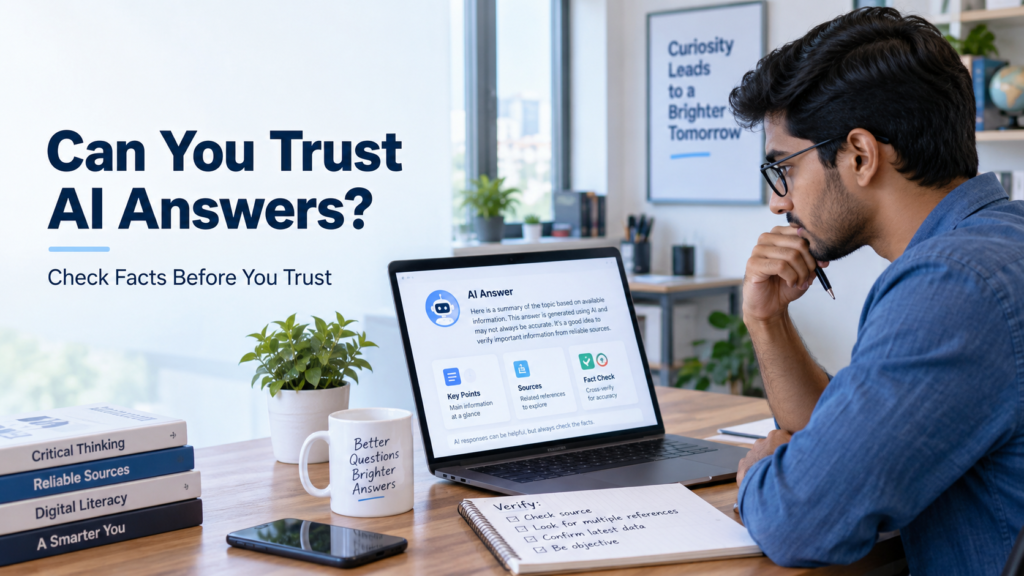
AI has become part of everyday life.
Students use it to understand difficult topics. Job seekers use it to prepare for interviews. Creators use it to plan content. Office workers use it to summarise documents, write emails, and organise ideas.
And most of the time, AI gives an answer within seconds.
That speed is useful.
Learning how to verify AI information is becoming an important digital skill for students, professionals, creators, and everyday users in 2026.
But it creates a new problem too.
When an answer looks polished, detailed, and confident, it is easy to assume that it must be correct.
That assumption can be dangerous.
An AI response can sound convincing and still contain an outdated fact, a mixed-up detail, a made-up reference, or an explanation that is only partly correct.
So the important question in 2026 is no longer just:
“Can AI answer this?”
A better question is:
“How do I know whether this answer deserves my trust?”
The goal is not to become suspicious of every AI response. The goal is to know when verification matters and how to do it without wasting time.
A Confident Answer Is Not the Same as a Correct Answer
One reason people trust AI so quickly is the way it communicates.
AI does not usually sound uncertain in the same way a person might.
It can explain something in a clean structure, use professional language, and give several supporting points. That presentation can make the response feel more reliable than it actually is.
Imagine asking an AI tool about a government scheme, software feature, exam rule, tax deadline, or recent company policy.
The answer may look complete.
It may even include dates and names.
But if one important detail is wrong, the entire decision based on that answer can become a problem.
This is why presentation and accuracy should be treated as two separate things.
Good writing tells you that the answer is easy to read.
It does not automatically tell you that the answer is true.
Why AI Can Give Wrong Information
AI systems are designed to generate useful responses based on patterns, context, available information, and the instructions they receive.
They are not human experts checking every statement one by one before replying.
Sometimes the system may misunderstand the question.
Sometimes two similar facts may get mixed together.
Sometimes the information may have changed recently.
Sometimes there may not be enough reliable information available, but the response still tries to complete the answer.
This can produce what people often call an AI hallucination: information that sounds plausible but is not actually supported.
The problem is that these errors are not always obvious.
A completely ridiculous answer is easy to reject.
A mostly correct answer containing one false detail is much harder to notice.
The Risk Depends on What You Are Asking
Not every AI answer needs the same level of checking.
If you ask for ideas for a birthday message, verification probably does not matter much.
If you ask for five headline ideas for a blog post, you can simply choose the ones you like.
But if you are asking about medicine, money, legal rules, government services, travel requirements, academic facts, technical instructions, or anything that affects an important decision, verification becomes much more important.
The higher the cost of being wrong, the more carefully you should check the answer.
That is a useful rule to remember.
Start by Asking: “Could This Information Have Changed?”
Some facts remain stable for years.
Others can change within weeks, days, or even hours.
Before trusting an AI response, ask yourself whether the information is time-sensitive.
Prices change.
Software interfaces change.
Government policies change.
Exam schedules change.
Company leadership changes.
Product features change.
Job requirements change.
If the answer depends on what is true right now, treat freshness as part of accuracy.
An answer that was correct six months ago may no longer be useful today.
Look for Specific Claims, Not Just the Overall Message
A common mistake is reading an AI answer as one large block and deciding whether it “sounds right.”
Instead, break it mentally into individual claims.
For example, imagine an AI response says:
“This scholarship is available to students under 25, applications close on September 30, and selected students receive ₹50,000.”
That sentence contains several separate facts.
The age requirement could be correct while the deadline is outdated.
The deadline could be correct while the amount is wrong.
Verification becomes easier when you check the important claims individually instead of judging the whole paragraph.
Ask AI to Separate Facts From Suggestions
AI answers often mix factual information with advice.
Those are not the same thing.
Suppose you ask how to improve your resume.
The AI may tell you that a certain file format is required by a company and then suggest shortening your work experience section.
The first statement may be something you should verify.
The second is a recommendation that you can evaluate based on whether it makes sense for you.
A useful follow-up prompt is:
“Separate the factual claims in your answer from your recommendations. Tell me which facts should be independently verified.”
This does not guarantee accuracy.
But it helps you identify what deserves extra checking.
Ask for Uncertainty Instead of Pretending Everything Is Certain
One simple way to improve an AI conversation is to invite uncertainty.
Instead of asking only:
“What is the answer?”
Try asking:
“Which parts of this answer are you most uncertain about?”
Or:
“What assumptions are you making here?”
Or:
“What information would change this answer?”
A useful answer should not just give a conclusion. It should help you understand where that conclusion may be weak.
This habit is especially valuable when the subject is complicated or incomplete.
Check Important Information Against a Primary Source
When a fact really matters, the strongest verification usually comes from the organisation responsible for that information.
If you are checking an exam rule, look for the official exam authority.
If you are checking a university requirement, look at the university itself.
If you are checking a product feature, look at the product’s official documentation.
If you are checking a government process, look at the relevant government department.
Secondary articles can still be useful for explanations, but primary sources are often better for confirming rules, dates, limits, eligibility, and official procedures.
You do not need to verify every sentence this way.
Focus on the details that could affect your decision.
Be Careful With AI-Generated References
Sometimes an AI answer may mention a study, article, report, book, court case, or research paper.
Do not assume that every reference exists just because it looks professionally formatted.
This is one area where verification is especially important.
If a reference matters to your work, search for the exact title, author, organisation, or publication.
If you cannot find it anywhere reliable, do not use it as evidence.
For students and researchers, this is particularly important.
A fictional citation inside an assignment is much worse than having no citation at all.
Numbers Deserve Extra Attention
Numbers often make an answer feel authoritative.
Percentages, dates, rankings, prices, limits, statistics, salaries, and growth figures can make a response look precise.
But precision does not guarantee correctness.
Whenever a number affects an important conclusion, ask:
Where does this number come from?
How recent is it?
What exactly does it measure?
Is it a national figure, global figure, estimate, average, or example?
A number without context can be technically correct and still be misleading.
Watch for Answers That Are Too Convenient
Sometimes an AI response tells us exactly what we hoped to hear.
That is when we may be least likely to question it.
Imagine you ask whether a shortcut is allowed, whether a rule applies to you, or whether a particular tool guarantees a result.
If the answer strongly supports what you already wanted to believe, take an extra moment to verify it.
This is not just an AI problem.
Humans also tend to accept information more easily when it matches their expectations.
AI simply makes that information faster to obtain.
Use a Second Question Before Using a Second Tool
Many people immediately open another AI tool when they are unsure about an answer.
Sometimes that helps.
But two AI systems agreeing does not automatically prove that the information is correct.
They may be relying on similar information or making similar assumptions.
Before switching tools, challenge the first answer.
Ask:
“What is the strongest reason this answer could be wrong?”
Then ask:
“Give me an alternative interpretation.”
Then:
“Which claim should I verify first?”
This often exposes weak areas quickly.
After that, if the information still matters, check an independent reliable source.
Do Not Confuse Explanation With Evidence
AI can be excellent at explaining complicated ideas in simple language.
That is one of its biggest strengths.
But an explanation is not the same as evidence.
For example, an AI tool may clearly explain why a particular economic trend happened.
The explanation may sound logical.
But if you are using that explanation in a report, article, assignment, or business decision, you may still need real data to support it.
Think of AI as something that can help you understand a topic.
Do not automatically treat every explanation as proof.
Verification Does Not Mean Doing Everything Twice
At first, fact-checking may sound like it defeats the purpose of using AI.
If you have to check every answer manually, why use AI at all?
Because you usually do not need to verify everything.
Use AI for speed, structure, brainstorming, clarification, summarisation, and first-pass understanding.
Then verify the small number of facts that carry the most risk.
A five-minute check of one important claim can be more valuable than spending thirty minutes researching the entire topic from zero.
The skill is knowing what deserves attention.
A Simple Verification Routine
Before using an AI answer for something important, run through this quick check:
- Is this information current or could it have changed?
- Does the answer contain exact dates, numbers, rules, or eligibility requirements?
- Is the AI making an assumption about my situation?
- Can I confirm the important claim from an official or reliable source?
- Is any reference, study, or citation actually real?
- Would being wrong here cost me money, marks, time, access, or a serious decision?
- Does the answer clearly separate facts from opinions or suggestions?
You do not need to spend long on every point.
The purpose is simply to slow down before trusting something important.
What Students Should Verify
Students often use AI because it can explain things faster than searching through several pages.
That can be genuinely helpful.
But students should be especially careful with historical dates, scientific facts, formulas, quotations, academic references, definitions, and assignment requirements.
If you are learning a concept, AI can help explain it in different ways.
If you are submitting that information for marks, the standard should be higher.
Do not let convenience turn into careless copying.
What Job Seekers Should Verify
Job seekers may use AI to research companies, prepare interview answers, improve resumes, or understand job descriptions.
Here, the biggest risks often involve outdated company information, invented achievements, salary assumptions, and inaccurate role requirements.
Use AI to improve how you communicate your real experience.
Do not let it create facts about your career that you cannot defend in an interview.
The same rule applies to company research.
If you plan to mention a company’s recent project, leadership change, product, or achievement during an interview, confirm it first.
What Creators Should Verify
Creators face a different problem.
An incorrect fact can quickly become public.
If a blog post, video, Facebook post, or social media caption contains false information, the mistake can affect trust.
AI can help creators develop outlines, titles, examples, explanations, and drafts.
But factual claims should still be checked before publishing, especially when the topic involves health, finance, law, public figures, statistics, news, or current events.
The faster your publishing workflow becomes, the more important a verification habit becomes.
When You Should Stop and Ask a Human Expert
There are situations where checking another website is not enough.
If the decision involves serious medical treatment, legal action, significant financial risk, safety, or another high-stakes situation, AI should not be your final authority.
Use it to understand terminology.
Use it to prepare questions.
Use it to organise information.
But when professional judgement matters, involve a qualified person.
Knowing when AI is not enough is part of using AI well.
The Best Way to Trust AI Is Not Blindly
AI does not have to be perfect to be useful.
A calculator is useful because we know what kind of problem it solves.
A search engine is useful because we understand that results still need judgement.
AI should be approached in the same way.
The wrong mindset is:
“AI said it, so it must be true.”
Another bad mindset is:
“AI sometimes makes mistakes, so nothing it says can be trusted.”
The useful position is somewhere in between.
Let AI help you move faster.
Let it explain difficult ideas.
Let it challenge your thinking.
Let it help you organise information.
But keep responsibility for important decisions with yourself.
Final Thoughts
In 2026, knowing how to ask AI questions is only half of the skill.
The other half is knowing what to do with the answer.
A confident response can still be wrong. A detailed response can still be outdated. A perfectly written explanation can still be based on a weak assumption.
That does not make AI useless.
It means we need a better habit.
Use AI for speed.
Use judgement for trust.
And whenever the information really matters, verify the part that could hurt you if it turns out to be wrong. That simple habit can make AI far more useful — and far less risky.
🔎 Explore Next
Practical AI guides you may find useful