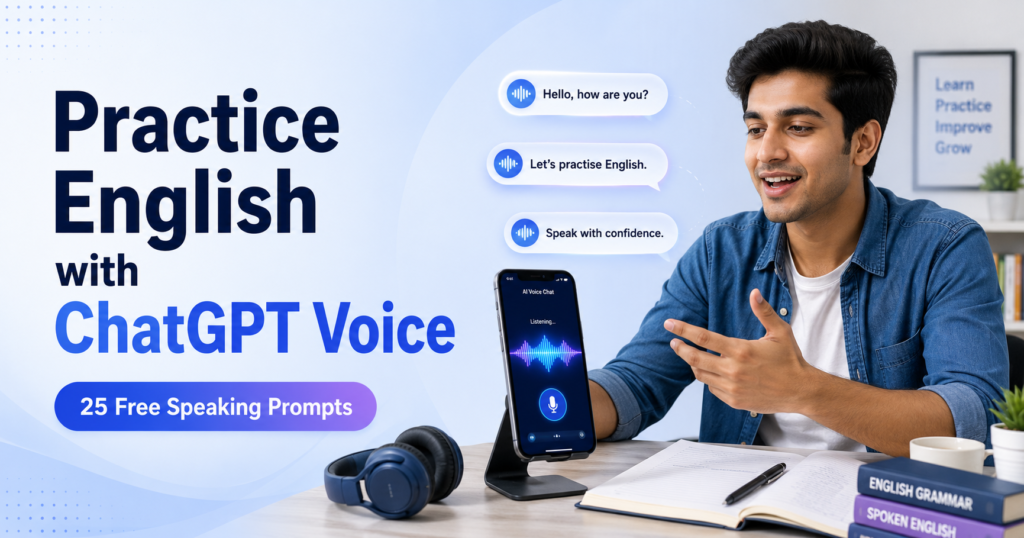
Learning English grammar is one thing. Speaking English confidently in a real conversation is completely different.
ChatGPT English speaking practice can help beginners build confidence through regular voice conversations, role-plays and instant feedback.
You may know hundreds of English words and understand most sentences, but when someone asks you a question in English, your mind suddenly goes blank. You start translating from Hindi, worry about making mistakes, and lose confidence before completing the sentence.
The biggest reason is simple: speaking improves through speaking.
However, finding a patient English-speaking partner is not always easy. Some learners feel embarrassed while practising with friends. Others cannot afford expensive spoken-English classes. This is where ChatGPT Voice can become a useful practice partner.
ChatGPT Voice allows you to speak naturally and hear spoken replies inside a conversation. You can also review the conversation text later, making it easier to notice mistakes and revise useful expressions. OpenAI describes Voice as a free-form spoken conversation experience within ChatGPT, although availability and usage limits may vary depending on the device, account and subscription plan.
This guide will show you how to use ChatGPT Voice for English speaking practice, what prompts to use, how to correct your mistakes and how to follow a simple 15-minute daily routine.
Also Read: https://aisikhoo.com/free-ai-tools-for-students-2026/
Can ChatGPT Voice Really Improve Your English Speaking?
ChatGPT Voice cannot magically make you fluent. It also cannot replace a qualified teacher, especially when you need professional pronunciation training or preparation for an important language examination.
What it can provide is regular conversation practice.
You can speak without worrying that another person will laugh at your grammar, accent or hesitation. You can repeat the same exercise several times, ask for simpler explanations and practise at any time that suits you.
ChatGPT Voice can be especially helpful for:
- Beginners who hesitate while forming sentences
- Students preparing for school or college viva examinations
- Job seekers preparing for interviews
- Professionals who need English for meetings
- Travellers learning basic conversational English
- Learners who understand English but cannot speak confidently
The goal is not to sound perfect from the first day. The goal is to become comfortable expressing your thoughts in English.
How to Start English Practice with ChatGPT Voice
The exact position of buttons may change across devices and app updates, but the basic process is straightforward.
- Open the official ChatGPT app or ChatGPT website.
- Sign in to your account.
- Open a new chat.
- Select the Voice option or voice-shaped icon.
- Allow microphone access when requested.
- Start speaking in English.
ChatGPT will listen to your speech and respond aloud. Depending on the current Voice experience, spoken responses may also appear as text in the conversation. After ending a Voice conversation, a transcript may be added to the chat so you can review what was discussed.
Begin with this instruction:
“I am learning spoken English. Please speak slowly, use simple words and correct only my important mistakes. Ask me one question at a time.”
This instruction is important because a normal AI response may be too long or advanced for a beginner.
If ChatGPT detects the wrong language, you can choose a preferred language in ChatGPT’s settings. OpenAI also notes that voice input may occasionally identify a spoken language incorrectly, so setting the preferred language can improve detection.
The Best Way to Practise: Do Not Ask Only for Lessons
A common mistake is asking:
“Teach me English.”
This request is too broad. ChatGPT may give you grammar rules, vocabulary lists and general advice, but that does not guarantee actual speaking practice.
Instead, give it a role and a clear activity.
For example:
“Act as a friendly shopkeeper. I am a customer buying a new phone. Speak to me in simple English and continue the conversation for five minutes.”
Now you have a real situation, a speaking role and a clear practice duration.
You should spend more time answering aloud than listening to explanations. A useful rule is:
Speak for 70% of the session and listen for 30%.
Whenever ChatGPT gives a long answer, politely interrupt and say:
“Please keep your replies short and let me speak more.”
25 ChatGPT Prompts for English Speaking Practice
Copy or speak any of these prompts according to your level.
Beginner Conversation Prompts
1. Daily introduction
“Ask me simple questions about my name, family, hometown and hobbies. Ask one question at a time and correct my answer gently.”
2. Morning routine
“Talk to me about my morning routine. Help me describe everything from waking up to starting work or study.”
3. My favourite food
“Ask me questions about my favourite food. Encourage me to answer in complete English sentences.”
4. Describe my room
“Help me describe my room in English. Ask about the furniture, colours, objects and location of each item.”
5. Weekend conversation
“Ask me what I normally do on weekends. Use easy English and give me a better sentence after each answer.”
Everyday Role-Play Prompts
6. Shopping at a store
“Act as a shopkeeper. I want to buy a shirt. Ask about size, colour, price and payment.”
7. Ordering food
“Act as a restaurant waiter. Help me order a meal, ask about ingredients and request the bill.”
8. Asking for directions
“Act as a local person. I will ask you how to reach a railway station. Correct my questions when needed.”
9. Doctor’s appointment
“Act as a clinic receptionist. Help me book a doctor’s appointment using polite and simple English.”
10. Hotel check-in
“Act as a hotel receptionist. I have a room reservation. Continue the conversation until check-in is complete.”
Student Practice Prompts
11. School viva
“Act as my teacher and conduct a simple viva on [subject]. Ask one question at a time and evaluate my spoken answer.”
12. Explain a topic
“Ask me to explain [topic] in English. After I finish, tell me how to make my explanation clearer.”
13. Classroom introduction
“Help me prepare a one-minute self-introduction for my first day at college.”
14. Group discussion
“Conduct a group-discussion practice on whether mobile phones are useful for students. Challenge my opinion politely.”
15. Presentation practice
“Listen to my two-minute presentation. Do not interrupt. After I finish, suggest improvements in structure, grammar and clarity.”
Job Interview Prompts
16. Basic interview
“Act as an interviewer for an entry-level job. Ask common interview questions one by one.”
17. Tell me about yourself
“Help me practise the answer to ‘Tell me about yourself.’ Ask follow-up questions based on my response.”
18. Strengths and weaknesses
“Ask me about my strengths and weaknesses. Help me make my answer professional but honest.”
19. Customer-service interview
“Conduct a customer-service job interview. Focus on communication, difficult customers and problem-solving.”
20. Salary discussion
“Act as a recruiter and practise a polite salary discussion with me. Use professional English.”
Fluency and Pronunciation Prompts
21. Slow speaking practice
“Speak slowly and ask me short questions. Wait until I finish completely before replying.”
22. Grammar correction
“Have a conversation with me. After every three answers, explain my three most important grammar mistakes.”
23. Better vocabulary
“During our conversation, suggest one natural English phrase that can replace a basic phrase I use.”
24. Pronunciation awareness
“Give me five short sentences to read aloud. After each sentence, tell me which words I should repeat more clearly.”
25. Fluency challenge
“Give me a simple topic. I will speak about it for one minute without stopping. Afterwards, evaluate my clarity, vocabulary and sentence formation.”
A Free 15-Minute Daily English Speaking Plan
You do not need to practise for two hours every day. A focused 15-minute session can be more useful than a long session done only once a week.
Minutes 1–3: Warm-Up
Answer three easy questions:
- How are you feeling today?
- What did you do this morning?
- What are you planning to do today?
Do not stop to correct every mistake. The purpose is to make your brain switch into English-speaking mode.
Minutes 4–8: Role-Play
Choose one real-life situation, such as ordering food, attending an interview, buying a product or asking for directions.
Ask ChatGPT to stay in character and keep its replies short.
Minutes 9–12: Correction
Say:
“Review my answers. Show me my five most important mistakes and give me the correct sentences.”
Read every corrected sentence aloud at least twice.
Minutes 13–15: Repeat and Record
Answer one earlier question again using the corrected language.
You can also record yourself using your phone’s recorder. Compare your first answer with the final answer. This makes your improvement easier to notice.
A Simple Seven-Day Practice Schedule
Following a theme prevents you from repeating the same conversation every day.
Day 1: Self-introduction
Practise your name, education, hometown, interests and goals.
Day 2: Daily life
Describe your routine, family responsibilities and weekend activities.
Day 3: Real-world role-play
Practise shopping, restaurant ordering, travelling or making an appointment.
Day 4: Storytelling
Describe a memorable day, childhood experience or recent problem.
Day 5: Opinion practice
Discuss social media, online education, AI tools or mobile-phone usage.
Day 6: Interview practice
Answer common job or college admission questions.
Day 7: Weekly review
Repeat the same introduction you gave on Day 1 and compare your fluency.
Save useful sentences in a notebook or digital document. Instead of memorising isolated words, collect complete phrases such as:
- “In my opinion…”
- “The main reason is…”
- “I am not completely sure, but…”
- “Could you please repeat the question?”
- “Let me explain it with an example.”
Complete phrases are easier to use during real conversations.
How to Ask ChatGPT to Correct Your English Properly
Too much correction can destroy your confidence. Too little correction can allow the same mistakes to continue.
Ask for selective feedback:
“Do not correct every small mistake while I am speaking. Let me finish first. Then correct only the mistakes that affect meaning or sound unnatural.”
You can request feedback in a simple table containing:
- What I said
- Correct sentence
- Short explanation
- Another example
Also ask ChatGPT to identify repeated mistakes. For example, you may regularly confuse “is” and “are,” past and present tense, or “he” and “she.” Fixing one repeated problem can improve your speaking faster than studying ten unrelated grammar chapters.
Important Limitations to Remember
ChatGPT is an AI system, not a human language examiner. Its corrections may occasionally be incomplete, unnecessary or inaccurate. AI systems can also generate confident-sounding information that is wrong, so important academic or professional guidance should be verified. OpenAI itself advises users to remain aware of model limitations rather than treating every response as guaranteed truth.
Pronunciation feedback should also be treated as general guidance. Different English accents are valid, and your goal should be clear communication—not copying one particular foreign accent.
Avoid sharing private information during practice. You do not need to provide your real address, financial details, passwords, identification numbers or confidential workplace information. Use imaginary details for role-play whenever possible.
You should also continue practising with real people. AI can help you build confidence, but human conversations teach you how to handle interruptions, emotions, unfamiliar accents and unexpected responses.
Common Mistakes Learners Should Avoid
Waiting Until Grammar Becomes Perfect
You do not need perfect grammar before speaking. Speaking is one of the ways through which grammar becomes automatic.
Translating Every Sentence from Hindi
Start with short English thoughts. Instead of creating a long Hindi sentence and translating it, speak in small parts.
For example:
“Yesterday I went to the market. I needed a new bag. The shop was crowded, but I found a good one.”
Simple sentences spoken confidently are better than complicated sentences that never come out.
Using the Same Prompt Every Day
Rotate between interviews, storytelling, role-plays, opinions and presentations. Different situations develop different speaking skills.
Allowing ChatGPT to Speak Too Much
Your session should not become an English podcast where ChatGPT speaks and you only listen. Regularly instruct it to ask short questions and wait for your answer.
Ignoring the Transcript
Reviewing the conversation is where many important improvements happen. Look for repeated errors, save natural phrases and speak the corrected sentences aloud.
Frequently Asked Questions
Is ChatGPT Voice free for English practice?
ChatGPT offers Voice access, but available features, daily limits and model access can vary by plan, platform and current product policies. Check the information shown inside your account for the most accurate limits.
Can beginners use ChatGPT Voice?
Yes. Beginners should ask it to speak slowly, use basic vocabulary, ask one question at a time and provide short corrections.
Can ChatGPT improve my pronunciation?
It can support pronunciation practice by giving words and sentences to repeat and offering general feedback. However, it should not be treated as a certified pronunciation assessment tool.
How many minutes should I practise daily?
Start with 10 to 15 minutes. Daily consistency is more important than practising for several hours once a week.
Can I practise job interviews with ChatGPT Voice?
Yes. Tell ChatGPT the job title, experience level and interview type. Ask it to behave like an interviewer and give feedback only after you complete each answer.
Should I use an Indian or foreign accent?
Use your natural accent. Focus on speaking clearly, choosing understandable words and forming complete sentences. Fluency does not require hiding your identity or copying a specific accent.
Final Thoughts
ChatGPT Voice can provide something every English learner needs: a patient conversation partner that is available whenever you are ready to practise.
But the tool works only when you speak.
Do not spend the entire session reading grammar explanations or collecting prompts. Open Voice, choose one situation and begin answering aloud. Make mistakes, review them and try the same answer again.
Follow the 15-minute routine for seven days. At the end of the week, record your self-introduction again. You may still make mistakes, but you will probably notice shorter pauses, better sentence formation and greater confidence.
English speaking is not a talent that some people are born with. It is a skill developed through repeated use. ChatGPT Voice can make that repetition easier, private and more accessible—but your consistency will create the real improvement.
Also Read:
How to Use AI for Exam Preparation in 2026: A Practical Study Guide for Students
Learn how students can create realistic study plans, practise questions, understand difficult concepts, and organize revision with AI.
How to Use AI for Job Search in 2026: A Practical Guide for Smarter Applications
Learn how to use AI for resume improvement, job research, interview preparation, application tracking, and professional follow-ups.
What Not to Share with AI Tools in 2026: 12 Things You Should Keep Private
Learn which passwords, documents, financial details, personal information, and confidential data you should avoid sharing with AI tools.
How to Fact-Check AI Answers in 2026: A Beginner’s 10-Step Checklist
Follow a practical checklist for checking AI-generated facts, dates, statistics, quotations, and important claims.
Free AI Tools for Students in 2026: Study Smarter with AI
Explore useful AI tools for studying, assignments, notes, exam preparation, and student productivity.